
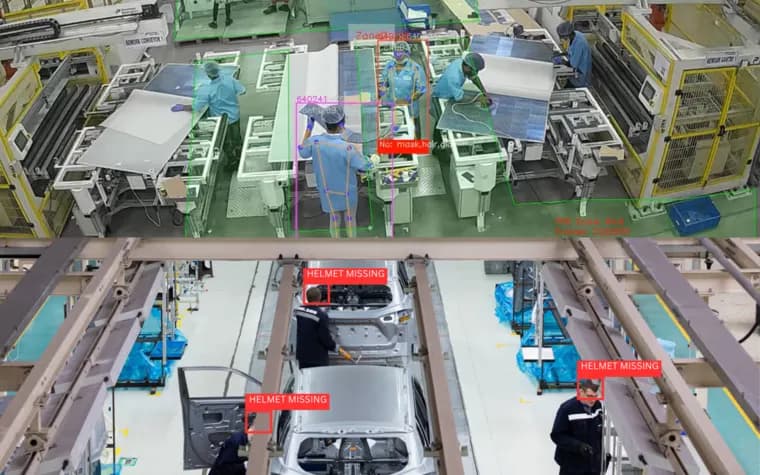
Almost every live construction site in India already has cameras: the security contractor installs them at the gate, the store, the batching plant and a few on masts over the work area. They are watched after a theft or an accident, if at all. AI video analytics changes what those cameras are for. Software watches the same feeds continuously and flags the moments that need a person: a worker without a helmet at the hoist, someone standing under a suspended load, a tipper reversing through a walkway, an exit blocked by rebar. The first question every project head asks is whether it works on the cameras they already have. Usually it does, with a few conditions that are different from a factory.
A site is not a factory
A factory camera looks at the same line for years. A site camera looks at a scene that changes every week: the excavation becomes a raft, the raft becomes columns, the mast camera that covered the whole plot now looks at the back of a tower crane. Dust, monsoon light, floodlights at night and reflective vests under them all change what a model sees. So the rules for a site deployment are stricter than for a plant.
- Pick cameras by zone, not by count: the gate, the crane radius, the hoist landing, the batching plant, the truck loop and the excavation edge are where incidents cluster.
- Angle and distance: a camera 30 to 60 degrees above the zone sees helmets and harnesses; a mast camera covering an acre sees headcount and vehicles, not gloves.
- Validate across a full day and night, in the weather the site actually has, before any alert counts.
- Plan to move cameras as the site changes; a camera review is part of the monthly programme, not a one-time install.
What existing site cameras do well
- PPE at entries and landings: helmets and vests reliably; harness clips where the camera is close enough.
- People in exclusion zones: under a suspended load, inside the crane slew radius, at the excavation edge, in the truck loop.
- Vehicle and pedestrian conflicts: tippers, transit mixers and loaders moving through areas where people are walking.
- Blocked egress and material stacked in front of fire points or escape routes.
- Headcount in a zone during a drill or an incident, and by subcontractor where zones are assigned.
- Housekeeping and barricading: open edges and missing guard rails at the end of a shift.
What they do not do
They do not see what the camera does not cover, and they do not stop a crane or a truck. AI video analytics alerts people; it is not a safety-rated system and never replaces permits to work, banksmen, guarding or your procedures. It cannot judge whether a scaffold is tied correctly or a trench is shored, and anyone who tells you it can is selling. What it does is make sure the site engineer and the HSE head see what the cameras see while the behaviour is still happening, and count what used to be remembered.
Where the processing happens
A compact edge unit in the site office runs detection locally. Footage stays on site, alerts go to the site engineer's phone or a WhatsApp group in under a second, and faces are blurred before any frame is stored. That last point matters more on a site than in a plant: subcontractor workers change weekly, and the system has to be about behaviour and zones, not about tracking individuals.
How a first site runs
- Week 1: walk the site with the HSE head and pick two to four cameras by zone. Move one or two if needed.
- Weeks 2 to 3: edge unit installed in the site office; streams connected over RTSP or ONVIF.
- Weeks 4 to 5: models validated across day, night and weather; alert rules agreed with the site team.
- Week 6: the HSE review runs on counted events per gate, per shift and per subcontractor, with the clip attached to each.
Which camera brands work?
Any camera that provides a standard RTSP or ONVIF stream, which covers Hikvision, CP Plus, Dahua, Axis, Bosch and most site NVR setups. Brand matters far less than angle, distance and light.
Does it work with subcontractor workers who change every week?
Yes, because detection is on behaviour and equipment, not identity. A missing helmet is a missing helmet whoever is wearing it; events are tagged by zone and shift, and by the subcontractor assigned to that zone.
Does footage leave the site?
Not unless you choose. Detection runs on the edge unit, faces are blurred before storage, and only events and clips reach the people you name.
PredCo runs this as site safety on existing CCTV for construction and infrastructure, starting with a scoped first site.
Written from deployment experience across multiple sites. Patterns are described without identifying any customer: we are under confidentiality with the operators involved.
Talk to an engineer about this