
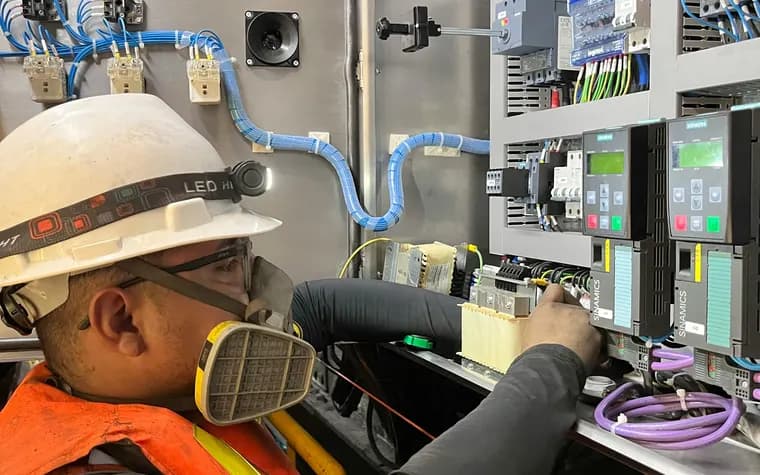
On a construction project, the equipment that matters is the equipment that stops the pour. A transit mixer can be replaced from the fleet. A batching plant mixer gearbox, a crusher bearing at the aggregate plant, or the DG set that powers the tower crane cannot, and when one fails mid-shift the schedule slips by a day and a queue of concrete trucks goes to waste. Maintenance on most sites is reactive, not because engineers do not know better, but because nobody is measuring the machines.
Why construction equipment fails without warning
- It moves: a batching plant is erected, run hard for eighteen months and dismantled. Its maintenance history, if it exists, is a logbook in a site office.
- It runs in dust, heat and rain, on a power supply that varies, with operators who change with the subcontractor.
- It is serviced by hours, not by condition: the gearbox oil is changed on schedule whether the bearing is failing or not.
- The failure is sudden only to the people not listening: a bearing announces itself weeks ahead in vibration and heat; a motor in current harmonics; a DG set in exhaust temperature and fuel burn.
The signatures that predict a failure
Predictive maintenance on construction equipment is the same discipline as in a plant, with the sensors chosen for a site. Three signals cover most of the fleet that matters:
- Vibration on mixer gearboxes, crusher bearings, screen drives and conveyor pulleys: the earliest warning, weeks ahead, if the sensor survives the site.
- Thermal: bearing housings, motor casings and DG exhaust; cheap, rugged and good at catching lubrication and load problems.
- Motor current signature: taken at the panel, away from the dust, it reveals rotor, bearing and load faults in the drive without touching the machine.
Fused into one model per asset, trained on that machine's own history, these produce a remaining-useful-life estimate with the signature that triggered it, so the plant engineer can verify before acting. Alerts without evidence are ignored by the third week; alerts with the vibration trace attached get acted on.
Starting on a site
- List the assets whose failure stops the pour or the crane: usually fewer than ten per site.
- Use the sensors you have first: panel current, existing temperature probes, the DG set's own controller data.
- Add rugged vibration sensors only on the drives that justify them: the mixer gearbox and the crusher.
- Run for four to six weeks to learn each machine's baseline before an alert counts, then review failures against the predictions at the monthly plant and machinery meeting.
Do we need to buy sensors for every machine?
No. Start with the data the machines already produce: panel current, controller logs, existing temperature probes. Add vibration sensors only on the few drives whose failure stops a pour.
What about equipment that moves between sites?
The model follows the asset, not the site. A batching plant's history travels with it when it is re-erected, which is exactly the record most contractors lose today.
Can the site engineer see it without a control room?
Yes. Alerts and the asset's health go to a phone or a weekly email; the detail is there when the plant engineer wants to verify a prediction.
PredCo runs this as asset reliability, on sites as well as plants.
Written from deployment experience across multiple sites. Patterns are described without identifying any customer: we are under confidentiality with the operators involved.
Talk to an engineer about this